Hermes: a personal AI agent on a 2 GB VPS, running on free models
An always-on assistant I talk to on Telegram, on a 2-core, 2 GB server and almost entirely free models. How it's put together, how it stays inside 2 GB, and a bug that lived between two projects.
Hermes is an always-on assistant I talk to on Telegram. It runs on a 2-core, 2 GB VPS and uses almost entirely free model tiers. It knows my projects, reads my own IDX news pipeline, and sends me briefs on a schedule. It has been running since October 2026.
I didn’t write the agent. It’s Hermes Agent, Nous Research’s open-source agent, which brings the tools, memory, skills, scheduler and Telegram gateway. My part is everything around it: which model answers what, how it fits on a small server, what it’s allowed to see, and how I find out when it breaks.
What it does
- Chat, around the clock. Research, writing, code and quick questions. It answers in whichever language I write, Indonesian or English, and replies appear as they’re written.
- Voice notes and screenshots. Voice is transcribed on the server with Whisper, so no audio leaves it. Photos and charts are read by a free vision model.
- Memory. It keeps a profile of me (timezone, interests, projects, goals) and turns tasks it has done into reusable skills.
- Routines, each delivered to Telegram:
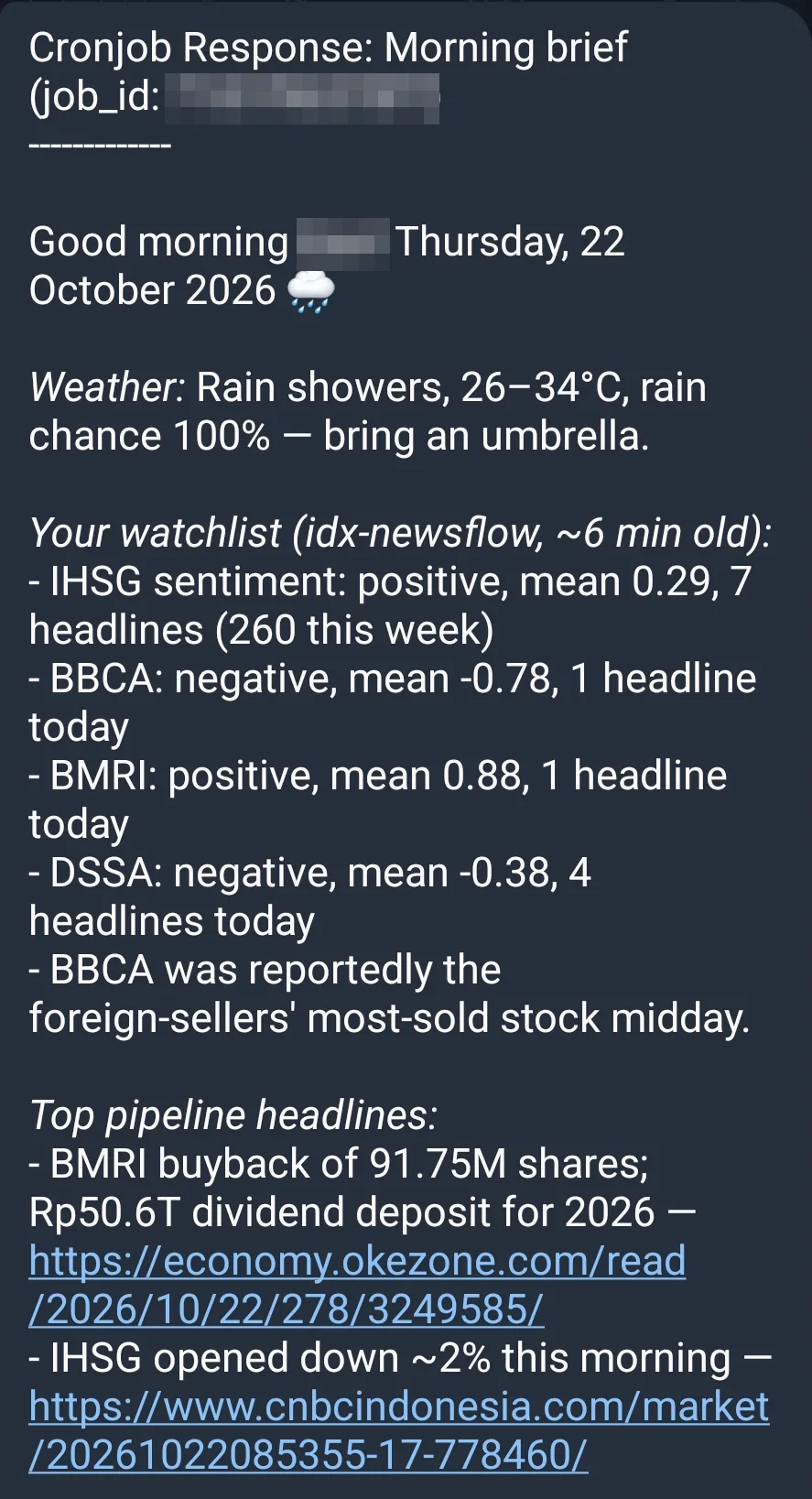
- Weekdays at 07:00, a morning brief. Jakarta weather; sentiment for my watchlist and the top-scored headlines from idx-newsflow, my news pipeline; then market context from web search, with sources: the IHSG close, the rupiah, Bank Indonesia.
- Sundays, a GitHub digest. Activity across my repos, open PRs and issues, and failing CI.
- Mondays, a scholarship check. Upcoming deadlines from ScholarTrack, filtered to Master’s programmes open to Indonesian applicants, with eligibility caveats flagged.
- Questions about my own data. “What’s the sentiment on BBRI this week?” is answered from the pipeline’s data, and the answer says how fresh that data is.
How it’s put together
Telegram
  ⇅
Hermes Agent · own user, systemd
  │ OpenAI-compatible API,
  │ localhost only
  ▼
9router · automatic fallback
  ├─ Claude Sonnet 4.5
  │    free credits
  │    → main answers
  ├─ OpenCode Free:
  │    GLM 5.3 Flash, MiniMax
  │    → chores, routines,
  │      fallback
  └─ OpenRouter free:
       Nemotron, Nemotron-VL
       → fallback, vision

Hermes also reads:
  idx-newsflow
    hourly read-only export,
    DuckDB → JSON
  ScholarTrack
    Supabase public API
  GitHub
    read-only token
9router is a local router with an OpenAI-compatible API. It pools free providers into one “combo” and falls back automatically when one runs out of quota.
The models are tiered on purpose. The scarce free Claude credits go only to real answers. Chores like titles, summaries, memory review and the scheduled routines run on a free GLM model. Hermes has its own second fallback chain, in case the router itself misbehaves.
Fitting it in 2 GB
With everything running, about 1 GB of memory stays available. Every service has a systemd memory cap. I left out the agent’s heavy browser tooling, and local Whisper fits under the agent’s 900 MB cap.
What it’s allowed to see
- Separate users. The agent runs as its own Linux user, without sudo. The router runs as another user that can’t log in, and the agent can’t read the router’s stored OAuth tokens.
- Nothing new on the internet. The router listens on localhost only. I reach its dashboard through an SSH tunnel.
- A copy of the data, not the pipeline. The agent can’t see idx-newsflow itself. It gets a read-only JSON export, refreshed hourly.
That export is the one place Hermes touches a live system, so it’s careful. It takes the same file lock the pipeline’s own jobs use, opens DuckDB read-only, and writes its file atomically. It never writes to the pipeline and never races the pipeline’s writers.
The bug between two projects
Reminders failed silently. The agent got empty responses while the router reported success.
Tracing both sides showed why. The router’s translator for the Claude provider treats any tool literally named tool_call as a special case. That’s also the name of the agent’s meta-tool for loading tools lazily, so the router dropped those calls. The fix was to turn lazy tool loading off.
Running it like a service
- Alerts that don’t depend on the agent. They go straight through Telegram’s bot API, so they still arrive when the agent is down.
- A health check every 10 minutes that spends no model credits. It sends one alert per incident and one on recovery.
- Daily backups. Consistent copies through SQLite’s online-backup API, pulled to my Mac by launchd every day.
- The rest: a weekly model-usage report, fail2ban on SSH, and a runbook with restore and rollback steps.
What it costs
Model spend is $0; the only cost is the VPS. Routing the chores to free models brought the scarce Claude credits down to about 2 of every 23 requests.
What I checked
The end-to-end checks passed: chat on Telegram, replies in Indonesian and English, voice transcription, reading a chart, scheduled delivery, fallback when the main model fails, failure and recovery alerts, and backup integrity.
The GitHub digest earned its place on its first run. It found two red CI pipelines in other projects, QuantDesk and idx-newsflow, and I opened fix PRs for both the same day.
What I learned
- Free tiers work for a personal agent if they’re tiered deliberately and there’s a fallback chain behind them.
- The bugs live in the seams. Agent frameworks and routers each assume things about tool names, reasoning parameters and streaming. When they disagree, both sides can report success, so log both sides.
- Give an agent a narrow, read-only view of production data, through an export rather than access.